
Aron Calvin Vijaykhar
Global Product Manager | Marketing & Brand Management Head
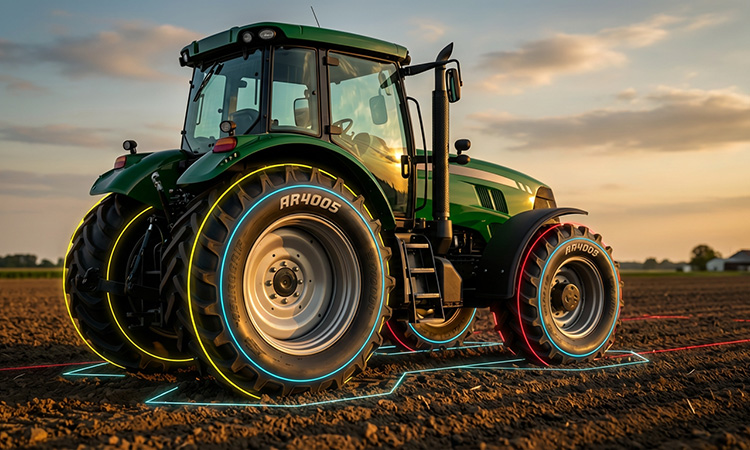
Gone are the days when aligning just the front wheels was enough. Today’s tractors demand four-wheel alignment not only for optimal tyre wear but for stability, fuel efficiency, and operator comfort.
Modern agriculture has seen staggering advancements in tractor and implement technology, precision farming, autonomous guidance systems, advanced suspension, and machines capable of traveling at speeds up to 90 kph. But there’s one critical area that remains alarmingly overlooked: steering geometry and alignment.
Farmers worldwide often overlook a deceptively impactful yet straightforward factor: wheel alignment (or implement alignment). Misalignment in tractors, planters, sprayers, and trailers not only erodes productivity but also drives up tyre wear, fuel consumption, and downtime.
As a leading off highway tyre manufacturer,OEM supplier, and exporter for 83+ countries, we understand how agriculture tyre alignment can positively impact farm profitability.
This article will be helpful to:
- Explore why alignment matters in agriculture, and its hypothetical hidden costs
- Offer actionable steps to optimize alignment
- Explain how tyres and alignment must co-design to maximize life
Agricultural tyres represent a major investment. So when a customer reports uneven front tyre wear, the usual suspect is the tyre itself. However, in most cases, the root cause lies deeper in misaligned steering geometry. Unfortunately, this isn’t well understood or communicated by many dealers or operators.
Here are a few key points:
- Road Transport: Tractors now spend more time on roads often traveling at speeds up to 90 kph. Any misalignment at these speeds causes rapid wear, particularly to the shoulders of front tyres.
- Suspension Systems: With the rise of front axle suspension and floating axles, alignment is no longer just about static geometry. Dynamic factors like camber, caster, and thrust angle play a significant role.
- Field Forces: Think of the torque and lateral forces at play in field operations, especially with large implements. These forces distort geometry over time, making periodic checks essential.
- Geographic Factors: In regions like the UK, steep road cambers amplify tyre wear on one side further underlining the need for proper camber and caster assessment.
Why Alignment in Agriculture Matters More Than You Think
1. Reduce Tyre Wear & Extend Equipment Life
Misalignment causes tyres to roll unevenly, forcing specific tread areas, often the inner or outer shoulders, to bear extra stress. This leads to irregular tread wear, vibration, and sidewall cracking. Over time, the internal casing of radial tyres can deform, cutting tyre life short.
Proper alignment distributes pressure evenly across the tread surface, ensuring consistent traction and longer durability. It also reduces heat buildup caused by excess friction, preventing rubber hardening and sidewall fatigue, common culprits behind premature tyre failure.
Moreover, misalignment doesn’t just affect tyres. It strains steering components, bearings, and suspension assemblies, leading to faster mechanical wear and costly repairs. Keeping alignment within manufacturer specifications minimizes these stresses, resulting in smoother handling, fewer breakdowns, and an extended overall service life for your equipment.
2. Lower Fuel Consumption & Improve Efficiency
When tyres or axles aren’t aligned, equipment has to “fight” internal resistance, which increases rolling drag. This extra effort forces the engine to burn more fuel. Studies in mechanized farming have shown that misalignment can raise fuel usage by 5–10%. Maintaining proper alignment allows machines to move freely, maximizing power efficiency and reducing fuel costs.
A Hypothetical Case Study of Hidden Cost
Let’s do a quick back-of-envelope calculation for a medium farm using tractors and implements:
Parameter | Effect of Misalignment |
|---|---|
Tyre replacement cost | 15% more frequent due to wear |
Extra fuel/year | 7% increased consumption |
Labour & maintenance | More frequent checks & stops |
Even a 5–10% bump in total operating cost due to misalignment swings margins negatively, especially for commodity crops where margins are tight.
3. Protect Crops & Soil Health
Misaligned implements such as planters or tillers disturb soil uniformity, leading to inconsistent seed placement, overlaps, or gaps. This unevenness affects germination and yield potential. Correct implement alignment maintains row precision and supports long-term soil and crop health.
Five Practical Steps to Better Alignment in the Field
1. Start with OEM-Level Setup
Ensure that tractors and implements arrive with correct spec alignment tolerances, toe, camber, caster, where applicable. Deviations beyond spec lead to cascading issues downstream.
2. Use Quality Tyres & Matching Load Index & Speed Symbol
Mixing tyres of different sizes, tread patterns, or load ratings invites imbalance problems. Using matched agricultural tyres, flotation tyres, or implement tyres from the same Eurogrip brand helps maintain harmony under load.
3. Routine Alignment Checks
At least seasonally (or every 500–1,000 km), measure alignment using laser tools or mechanical gauges. Look for toe-in/out offsets and lateral drift. Small corrections paid early.
4. Monitor Tyre Temperatures & Wear
Infrared scanning (on big farms) or visual tread checks can flag early misalignment. Uneven wear across tread width is a red flag.
5.Use a Tool like Haweka AXIS50 LM
We are not being paid to promote this system, but it is one I am qualified to use and have done in the past and that stands out in this evolving space is the Haweka AXIS50 LM, explicitly designed for agricultural applications. It provides accurate, repeatable four-wheel alignment measurements, ensuring that geometry is restored to OEM specifications or better.
For agricultural tyre dealers, contractors, and service providers, investing in such a system isn’t just a technical upgrade it’s a business decision that pays dividends in tyre life, machine uptime, and customer trust.
Alignment & Tyre Synergy: Why it Matters for TVS Eurogrip OHT
As a leader in agricultural tyres, OTR tyres, and industrial tyres, TVS Eurogrip OHT takes a systematic approach. We partner with OEMs to calibrate tyre geometry, load ratings, and rim–tyre matching, so the alignment is effective. Below are the benefits:
- Longer tyre life (up to 20–30% in optimized systems)
- Better fuel economy & lower total cost of ownership
- Global consistency for farmers in different terrains
- Reduced support costs and warranty claims
Our in-house R&D runs simulations and field trials across varied soil types and use cases, ensuring that alignment margins are practical.
Frequently Asked Questions (FAQs) on Alignment in Agriculture
Why is wheel alignment important in agricultural machinaries?
Proper wheel alignment in tractors and implements reduces tyre wear, fuel consumption, and downtime. Misalignment leads to uneven tread wear and higher operating costs, making alignment checks essential for farm profitability.
How often should farmers check tractor tyre alignment?
Experts recommend checking tractor alignment every 500–1,000 km of road transport, or at least once per cropping season. Alignment should also be inspected after heavy fieldwork, rough terrain use, or when operators notice uneven tyre wear.
What are the common signs of misalignment in farm equipment?
Some warning signs include:
- Uneven tyre wear on shoulders
- Steering pulling to one side
- Higher fuel usage
- Vibration or instability at transport speeds
- Identifying these early prevents costly damage.
Does misalignment affect fuel efficiency in tractors?
Yes. Misaligned wheels create extra rolling resistance, forcing the engine to work harder. This can increase fuel consumption by 5–10%, which adds up to significant costs over a farming season.
What tools are used for agricultural wheel alignment?
While older methods used strings and gauges, modern farms rely on laser alignment systems and four-wheel alignment tools such as the Haweka AXIS50 LM. These provide precise measurements to maintain OEM specifications.
How does alignment impact tyre life in agriculture?
Correct alignment can extend tyre life by 20–30%, reducing replacement costs. For farmers investing in radial, flotation, or implement tyres, maintaining alignment ensures maximum return on investment.