
Jed Soar
European Director - Technical Services & Product Performance
Central Tire Inflation Systems (CTIS) have been a topic of debate among agricultural and transport professionals, particularly when paired with advanced tire technology like Very High Flexion (VF) tires. The purpose of CTIS is to adjust tire pressures dynamically based on operating conditions, reducing soil compaction in the field and optimizing performance on the road. However, when considering European legal road speeds, which average around 40 km/h, the benefits of CTIS may be less pronounced, especially with VF tires. This article evaluates the need for CTIS on a typical setup, using a Fendt 936 Vario tractor and a fully loaded tanker as a case study.
What Is CTIS?
A CTIS (Central Tire Inflation System) is an automatic tire inflation system that monitors and adjusts tyre pressures from inside the cab while the vehicle is in motion. Originally developed for CTIS trucks and military 4×4 vehicles, it’s now used across agriculture, mining, and transport.
The central inflation system connects each wheel through air lines controlled by onboard valves and a CTIS software module. Operators can switch between field and road settings, ensuring tyres run at ideal pressures for traction, load, and speed.
In heavy-duty agricultural setups, CTIS helps reduce soil compaction by lowering pressure in the field and reinflating for stability during road transport. However, as discussed in this analysis, the benefit may be minimal with modern VF tyres, which already handle variable pressure ranges effectively.
Applications of CTIS in Modern Agriculture and Transport
The CTIS tire inflation system has evolved far beyond its original defence and off-road roots. Today, it serves multiple roles across farming, construction, and logistics:
1. Agricultural Operations: Farmers use CTIS to shift quickly between field and road pressures, improving VF tyre and soil performance. For slurry tankers, seeders, or grain trailers, automatic pressure control saves time and maintains tyre longevity.
2. Heavy Transport and Trucks: CTIS trucks and long-haul trailers use automatic tire inflation systems for trucks to balance load and reduce blowouts. Adjusting for payload variation ensures safer braking and even tread wear.
3. Off-Road & Utility Vehicles: On construction and forestry machines, or central tire inflation system 4×4 rigs, CTIS boosts traction on loose terrain and protects tyres against puncture risks.
4. Fleet Integration: Some manufacturers and the Central Tire Corporation now integrate CTIS with telematics and pressure-monitoring dashboards for full fleet analytics. This allows predictive maintenance and efficient scheduling through integrated CTIS software systems.
Case Study: Fendt 936 Vario and 26,000 litre Slurry Tanker Configuration
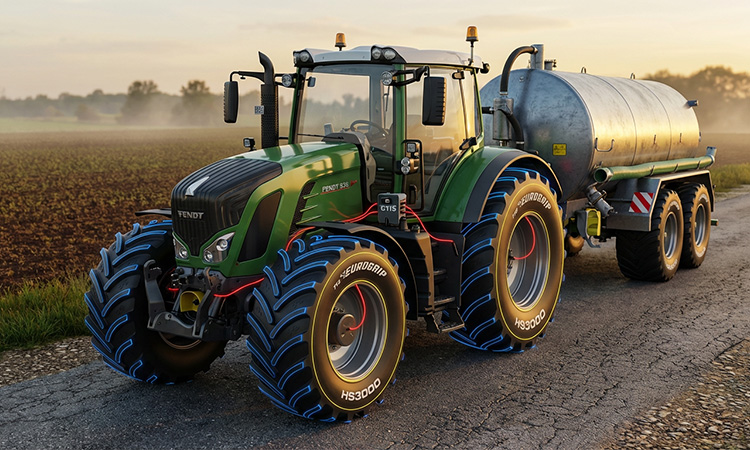
Let’s consider a Fendt 936 Vario tractor, which weighs around.11,360 kg, equipped with VF710/75R42 rear tires and VF600/70R34 front tires. The tractor can reach a maximum speed of 65 km/h, although the average legal road speed in Europe is much lower. The tractor is towing a loaded tanker that weighs 36,000 kg, fitted with VF750/60R30.5 tires, each bearing an average load of 5,400 kg.
VF Tires: A Game Changer in Tire Technology
VF tires are designed to carry heavy loads at lower pressures without compromising tire integrity or performance. They offer a significant advantage in the field by reducing soil compaction and enhancing traction. When transitioning to road use, VF tires are capable of maintaining a relatively low inflation pressure, even at higher speeds, without overheating or compromising safety.
In the scenario described, VF tires would require only a slight increase in pressure—an average of 0.2 bar—when moving from field operations to road transport. This minimal change in pressure raises the question: is the investment in CTIS, which can be a costly and complex system, justified for such a small pressure adjustment?
Scenario Analysis: Field to Road Transition
Scenario 1: Operating in the Field
In the field, the Fendt 936 Vario operates at lower speeds, typically under 20 km/h. The VF tires are set to a lower pressure to maximize the contact area with the ground, reducing soil compaction and improving traction. For example, in field operations, the rear tires might be set to 0.8 bar, and the front tires to 0.8 bar. The tanker’s tires would be at be 0.8 bar also.
Scenario 2: Road Transport
When transitioning to road transport, where the average speed is 40 km/h, the VF tires require only a small pressure increase to ensure stability and reduce rolling resistance. The rear tires may need to be adjusted to 1.0 bar, the front tires to 1.0 bar, and the tanker’s tires to 1.0 bar. This represents anincrease of just 0.2 bar across all tires.
Is CTIS Worth the Investment?
Argument Against CTIS
1.Minimal Pressure Adjustment: The average increase in pressure when transitioning from field to road is only 0.2 bar. This small adjustment can be made manually without significant time loss or risk. Given that the pressure adjustment is minimal, the benefits of an automated CTIS may not justify the high cost of installation and maintenance.
2.Legal Speed Limitations: With European road speed limits for agricultural vehicles averaging around 40 km/h, the risk of tire damage due to under-inflation at higher speeds is greatly reduced. VF tires are specifically designed to handle variations in pressure without compromising performance, making the case for CTIS less compelling.
3.Cost Considerations: CTIS can be an expensive addition to a tractor-tanker setup. The cost includes the initial purchase, installation, and ongoing maintenance. For a setup where the pressure difference between field and road conditions is minimal, this investment might not offer a reasonable return.
Argument for CTIS
1.Convenience and Efficiency: While the pressure adjustment might be small, CTIS offers the convenience of automatic adjustments without the need for manual intervention. This can save time, especially in operations where vehicles frequently transition between field and road conditions.
2.Long-Term Tire Health: Even slight under-inflation on the road can lead to increased tire wear over time. CTIS ensures that tires are always operating at optimal pressure, potentially extending tire life and reducing long-term costs.
3.Safety and Stability: CTIS can improve vehicle stability by ensuring that tire pressures are always correctly adjusted for the load and speed, reducing the risk of accidents, particularly when carrying heavy loads like a fully loaded tanker.
The Future of CTIS and VF Tyres
As tractors, trucks, and trailers become increasingly connected, the integration of CTIS systems with smart VF tyres is expected to become more seamless. The next generation of central inflation systems will link tyre sensors to GPS-based load data, allowing automatic adjustment by task, soil type, and weather.
However, the balance between investment and necessity remains. While CTIS tire inflation systems improve convenience and safety, VF tyre technology already minimizes the need for drastic pressure variation. The future likely lies in hybrid setups—vehicles equipped with both CTIS and VF tyres, using intelligent algorithms to manage load and terrain in real time.
Conclusion: Evaluating the Necessity of CTIS with VF Tires
In the context of European agricultural operations, where legal road speeds average 40 km/h, the need for CTIS when using VF tires is debatable. The minimal pressure increase required when transitioning from field to road conditions suggests that the benefits of CTIS might not justify the cost. VF tires already offer a high degree of flexibility and performance, reducing the need for constant pressure adjustments and currently are greatly underused by a high proportion of farmers and contractors, opting for utilizing standard tyre pressures when having VF fitted.
However, for operations that prioritize convenience, efficiency, and long-term tire health, CTIS could still be a worthwhile investment. Ultimately, the decision to invest in CTIS should be based on a careful consideration of operational needs, budget constraints, and the specific conditions under which the equipment will be used.
Frequently Asked Questions (FAQs)
What is CTIS?
CTIS (Central Tire Inflation System) automatically adjusts tyre pressure for varying conditions. It connects all tyres via air lines controlled by CTIS software, ensuring optimal performance and safety.
How does a CTIS tire inflation system work?
The system uses compressors, valves, and sensors to inflate or deflate tyres while driving. Operators can switch between road and field modes using a central control interface.
Is CTIS useful for VF tyres?
VF tyres already operate efficiently across wide pressure ranges, reducing the need for frequent inflation changes. CTIS adds convenience but may not be essential for small pressure adjustments.
Where is CTIS commonly used?
It’s widely used in trucks, agricultural tractors, and construction vehicles. Modern CTIS trucks and 4x4s use it for load balancing, terrain management, and fuel savings.
Who develops or supplies CTIS technology?
Companies like Central Tire Corporation and several OEMs integrate CTIS systems into vehicles with advanced telemetry and predictive maintenance capabilities.
What is an automatic tire inflation system for trucks?
It’s a variant of CTIS that continuously monitors tyre pressure in long-haul fleets, automatically correcting deviations to prevent blowouts and uneven wear.