
Aron Calvin Vijaykhar
Global Product Manager | Marketing & Brand Management Head
In the high-stakes world of open-pit and underground mining, tires are more than just rubber; they are a significant operational expense. Selecting the wrong specification can lead to rim slippage, bead failure, and dangerous blowouts. A common point of confusion for fleet managers is the difference between two visually similar sizes: 14.00-24 and 14.00-25.
While they share the same nominal section width (14 inches), they are not interchangeable. As we move into 2026, understanding the technical nuances of these mining truck tyre size specifications is vital for maximizing the uptime of your mining equipment tyres.
This Mining Tyres Comparison guide breaks down the engineering differences, applications, and market availability for mining tyres in key regions like India, South Africa, and Australia.
14.00-25 vs 14.00-24 Mining Tyres Explained
In the mining industry, a single inch of difference is not a margin of error it is a safety hazard. One of the most dangerous and costly mistakes fleet managers make is confusing 14.00-24 and 14.00-25 tyres. While they share the same 14-inch section width, they are engineered for completely different wheel rims and applications.
As we head into 2026, with the cost of mining equipment tyres rising, you cannot afford fitment errors.
1. Rim Diameter and Bead Seat Profile
The fundamental difference between these two sizes lies in how the tire “sits” on the wheel. This is defined by the Bead Seat Profile.
• 14.00-24 (Flat/Semi-Drop): This tire is designed for a 24-inch rim with a Flat Base or Semi-Drop Center. The bead of the tire sits relatively flat against the rim surface. It relies on the flange ring to hold it in place.
• 14.00-25 (Tapered): This tire is designed for a 25-inch rim with a 5-Degree Taper. The rim surface is sloped. When the tire is inflated, the bead is forced up this slope, creating a tight “interference wedge.” This wedging action is critical for preventing the tire from slipping on the rim under high torque.
2. 14.00-24 for Grader and 14.00-25 for Earthmover
To simplify selection, the industry generally categorizes these sizes by machine type:
• 14.00-24 = The “Grader” Standard: Often marked with the code TG (Tractor Grader) or G-2/G-3. It is engineered for traction and stability, essential for leveling ground.
• 14.00-25 = The “Earthmover” Standard: Often marked with OR (Off-Road) or E-3/L-3. It is engineered for load-bearing and massive torque transfer, essential for digging and hauling.
3. Application of 14.00-24 vs 14.00-25
Misapplication leads to premature failure. Here is where each tire belongs:
Feature | 14.00-24 | 14.00-25 |
|---|---|---|
Primary Machine | Motor Graders (e.g., CAT 140), Mobile Cranes | Wheel Loaders (e.g., CAT 966), Rigid Dump Trucks |
Operational Role | Precision leveling, surface finishing, lifting | Digging, loading ore, hauling heavy payloads |
Torque Requirement | Moderate (Traction focused) | High (Breakout force focused) |
Speed Rating
| Typically higher (A8) for roading graders | Lower (A2/B) for load-carrying |
Why the difference? A wheel loader digging into a rock pile generates immense torque. If it used a flat-base 14.00-24 rim, the tire might slip and spin on the wheel. The 14.00-25 tapered rim locks it in place.
4. 2026 Global Price Trends: India, Australia & South Africa
The market for mining tyres for sale is stabilizing in 2026. Here is the outlook for both sizes:
India:
+ Trend: Domestic manufacturing is booming due to the NHAI infrastructure push.
+ Price: A high-quality bias 14.00-25 ranges from ₹45,000 to ₹55,000. The 14.00-24 grader tyre is slightly cheaper, averaging ₹35,000 to ₹45,000.
Australia (Perth/QLD):
+ Trend: Fleet managers are moving to “Value Tier” bias tires for support equipment (Graders) to save costs, while keeping premium radials for primary Haul Trucks.
+ Price: Expect to pay $800 – $1,200 AUD for reliable bias-ply mining tyres.
South Africa:
+ Trend: High demand for Cut-Resistant compounds due to deep-level gold/platinum mining.
+ Price: Prices are 15-20% higher than India due to logistics, with strong demand for 14.00-25 smooth (L5S) underground tyres.
5. Buying Guide for 14.00-24 and 14.00-25
When purchasing, look beyond the size. Check these three specs:
1. Ply Rating (PR):
For 14.00-24: Look for 12 PR to 16 PR. You need flexibility for the grader to mold over uneven ground.
For 14.00-25: Look for 20 PR to 28 PR. You need sidewall stiffness to carry heavy buckets of ore without swaying.
2. Compound:
If you are in mining tyres South Africa (hot mines), ensure the tire has a Heat Resistant compound. Standard compounds may separate under 24-hour hauling cycles.
3. New vs. Used:
Never buy used 14.00-25 tires for a primary loader. The casing fatigue is invisible but dangerous. Used 14.00-24 tires are acceptable for backup graders if the bead is undamaged.
6. Product Spotlight for 14.00-24 and 14.00-25
TVS Eurogrip offers specific solutions for both applications:
For 14.00-24 (Grader): TVS Eurogrip TG 09
• Pattern: L-2 / G-2 (Traction)
• Key Feature: Open tread design for self-cleaning. It prevents mud buildup, ensuring the grader blade stays level even on slick clay.
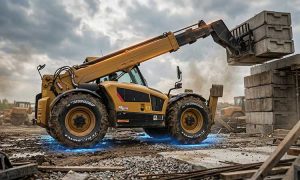
• Best For: Motor Graders and Telehandlers.
For 14.00-25 (Earthmover): TVS Eurogrip EM 27
• Pattern: E-3 / L-3 (Rock)
• Key Feature: Massive, robust lugs with a high “land-to-sea” ratio for impact resistance. The heavy-duty nylon casing is built to withstand the breakout force of loading operations.
Best For: Wheel Loaders and Dumpers.
Why You Cannot Interchange Them
Attempting to mount the wrong size is the leading cause of workshop accidents involving mining vehicle tyres.
• 24″ Tire on 25″ Rim: The rim is too big. If you try to force the tire on, the steel bead wire will snap with explosive force, often resulting in fatal injury to the tire fitter.
• 25″ Tire on 24″ Rim: The rim is too small. The tire will not seal, and even if it inflates, the machine’s torque will cause the rim to spin inside the tire, grinding the bead to shreds and causing a blowout.
Always match the rim diameter exactly.
Frequently Asked Questions (FAQs)
Can I mount a 14.00-24 tyre on a 14.00-25 rim?
Absolutely not. The rim diameters are different (24 inches vs. 25 inches). Attempting to mount them can cause the tire bead to break or the tire to explode during inflation, which is a fatal safety hazard.
What is the price of mining tyres in India?
The mining truck tyres price in India for a 14.00-25 bias ply tire typically falls between ₹45,000 and ₹78,000, depending on the ply rating (PR) and brand.
Are 14.00-25 tyres suitable for underground mining?
Yes. Many underground mining tyres use the 14.00-25 size with a specialized L5S (Smooth) tread pattern. This smooth design provides maximum cut resistance against jagged rocks in underground tunnels.
Where can I find mining tyres for sale in Australia?
You can find mining tyres Perth and nationwide through specialized OTR dealers. Suppliers like Tyre Doctor stock a wide range of mining dump truck tyres specifically for Australian conditions.
What is the difference between E3 and L3 mining tyres?
E3 refers to “Earthmover” (for transport/hauling, like dump trucks) with a normal tread depth. L3 refers to “Loader” (for digging/loading) with the same tread depth. While the tread depth is similar, the internal construction often differs to handle speed (E3) vs. torque (L3).
What machinery uses 14.00-24 tyres?
This size is most commonly found on motor graders, mobile harbor cranes, and older mining trucks. It is also a standard size for heavy-duty port vehicles like reach stackers.