
Aron Calvin Vijaykhar
Global Product Manager | Marketing & Brand Management Head
You just bought a new compact tractor, or maybe you are replacing the worn-out rubber on your trusty utility machine. You look at the sidewall, and you see codes like “R-1,” “R-4,” or “R-3.”
It can be confusing. Choosing the wrong farm tractor tires is not just a matter of aesthetics; it changes how your machine performs. The wrong choice can leave you stuck in the mud, tearing up your manicured lawn, or wearing out your treads in just a few months.
The two most common choices for utility tractors are R-1 tires and R-4 tires. But what is the difference? And which one is right for your specific mix of field work, loader work, and lawn care?
In this guide, we will break down the R-4 vs R-1 tires debate, explain tractor tyre tread pattern differences, and help you pick the perfect set for your needs.
Overview of R-1 and R-4 Tire Classifications
Before we compare them, we need to understand what these codes mean. The “R” stands for “Rear” tractor tires (though today they are used on all positions for 4WD tractors).
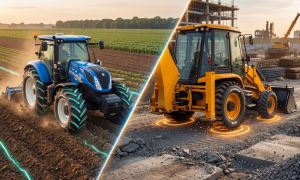
- R-1 Tires (Ag / Bar Tread): These are the classic agricultural tires you see on field tractors. They have deep, widely spaced lugs designed for maximum traction in dirt.
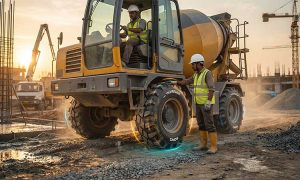
- R-4 Tires (Industrial): These are known as industrial tractor tires or “utility” tires. They have wider, shallower lugs and a tougher casing. You often see them on backhoes, telehandlers, and skid steers.
- R-3 Tires (Turf): These are tractor turf tires designed with a diamond or button pattern to float over grass without damaging it.
R-1 Tires: The Agricultural Workhorse
If your tractor lives in the dirt, the R-1 is your best friend.
The Design
R-1 tractor tires feature aggressive cleats (lugs) that are spaced far apart. The angle of these lugs (usually 23 to 45 degrees) acts like a paddle. As the tire spins, the lugs bite deep into soft soil, and the wide space between them allows mud to fall out (self-cleaning).
Best Applications
- Plowing and Tilling: When you need to pull a plow through heavy clay, you need the aggressive bite of an ag tire.
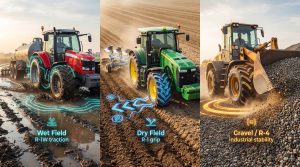
- Mud and Snow: R-1s are superior in wet conditions. If you work in a feedlot or a muddy field, these tires keep you moving.
- Hillside Mowing: The deep lugs provide stability on slopes where smoother tires might slide.
The Downside
R-1 tires are aggressive. If you drive them across a wet lawn, they will leave deep ruts. On hard pavement, they wear out quickly and give a bumpy ride because you are bouncing from lug to lug.
R-4 Tires: The Versatile Performer
The R-4 industrial tires are the “SUV tires” of the tractor world. They are a hybrid designed to do a little bit of everything.
The Design
R-4 tires typically have lugs that are about 70% as deep as an R-1. The lugs are also wider and spaced closer together. The tire carcass is usually constructed with thicker sidewalls to handle heavy weights.
Best Applications
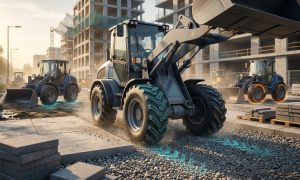
- Loader Work: If you use a front-end loader to move gravel or dirt, R-4s are ideal. The stiff sidewall creates stability, so the tractor doesn’t wobble when the bucket is full.
- Hard Surfaces: Because the lugs are wider and flatter, they run smoother on concrete, asphalt, and gravel driveways.
- Construction Sites: They are puncture-resistant, making them great for sites with debris. This is why they are standard payloader tires or backhoe tires.
The Downside
The weakness of the R-4 is thick mud. Because the lugs are shallow and close together, they can get “packed” with mud, turning the tire into a slick slick.
Head-to-Head Comparison: R-4 vs R-1 Tires
Let’s look at how they stack up in specific scenarios to help you make the right choice.
1. Traction (Mud & Loose Soil)
When the going gets tough, tread depth is everything. R-1 tires feature aggressive, deep cleats spaced widely apart to allow heavy mud and sticky clay to shed easily as the wheel rotates. This “self-cleaning” action ensures you always have a fresh biting edge to pull through the muck. In contrast, the R-4’s shallower, wider lugs tend to fill up with mud quickly, effectively turning your tire into a smooth “slick” that loses grip instantly in wet field conditions.
- Winner: R-1 Tires
2. Durability and Load Capacity
Industrial work is brutal on rubber. R-4 tires are specifically engineered with tougher, puncture-resistant compounds and reinforced, stiff sidewalls to handle the massive static weight of full loader buckets or backhoes. While R-1 tires are durable enough for tillage, their thinner, flexible sidewalls are designed for field traction and are much more vulnerable to punctures from common construction debris like rebar, sharp rocks, or jagged concrete edges found on job sites.
- Winner: R-4 Tires
3. Lawn Friendliness
If you care about the look of your grass, ground pressure is key. R-1 tires have sharp, narrow lugs that concentrate the tractor’s weight into small pressure points, which acts like a tiller, slicing through turf and leaving deep ruts, especially during tight turns. R-4 tires offer a wider, flatter contact patch that distributes the machine’s weight more evenly across the surface. While they aren’t as gentle as dedicated R3 turf tires, they are significantly less damaging to established lawns than aggressive Ag treads.
- Winner: R-4 Tires
4. Road Comfort & Hard Surface Wear
Driving a tractor with agricultural tires on asphalt can feel like riding a jackhammer. The wide spacing between R-1 lugs causes a harsh vibration known as “lug slap,” which is uncomfortable for the operator and causes the lugs to wear down unevenly and rapidly. R-4 tires feature closely spaced lugs that often overlap in the center, creating a nearly continuous rolling surface. This design offers a much smoother, quieter ride on hard surfaces and significantly better longevity when traveling between locations.
- Winner: R-4 Tires
Tractor Tyre Tread Pattern: Why It Matters
When searching for sizes like 18.4-38 tractor tires or smaller compact sizes, the tread pattern is just as important as the dimension.
- Self-Cleaning: This is the ability of the tire to eject mud. R-1s are excellent at this. R-4s are average.
- Contact Patch: R-4 tires put more rubber on the ground. This improves wear life on abrasive surfaces like concrete but reduces the ground pressure needed to bite into soil.
What about Radial Ply Tyres? Both R-1 and R-4 patterns can come in Bias or Radial construction.
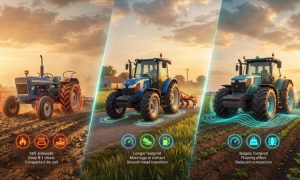
- Radial Ply Tyre: These have flexible sidewalls that create a larger footprint. A Radial R-1 (often called R-1W) gives you the best of both worlds: deep traction lugs with a wider footprint to reduce compaction.
What’s the Difference Between G, L, and E Tires?
You might see other letters on back tractor tires or industrial equipment. Here is a quick breakdown to answer: whats the difference between g, l and e-tires?
These are “Off-The-Road” (OTR) codes used for heavy construction and mining, not usually standard farm tractors.
- G (Grader): Designed for motor graders. They focus on traction and directional stability.
- L (Loader/Dozer): Designed for wheel loaders and bulldozers. They have incredibly thick treads and sidewalls to resist rock cuts. Example: An L-3 is a standard depth, while an L-5 is extra deep for rock mining.
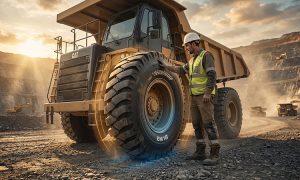
- E (Earthmover): Designed for dump trucks (haulage). They are built to resist heat build-up during long trips at higher speeds.
Radial Ply Tyres vs Bias Ply Tyres
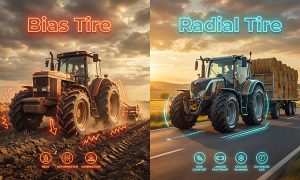
Both R-1 and R-4 tyres are available in radial ply tyre and bias-ply constructions.
Radial tyres offer better flexibility, improved traction, and reduced soil compaction. They are often more fuel-efficient and comfortable to operate. Bias-ply tyres, while stiffer and less flexible, are generally more resistant to sidewall damage and cost less upfront.
Choosing between radial and bias construction depends on workload, budget, and terrain. For long working hours and heavy loads, radial tyres are often preferred.
Conclusion
Choosing between R-4 vs R-1 tires is not about which tyre is better overall, but which tyre is better for your work. R-1 tyres remain the best choice for agricultural traction and field productivity. R-4 tyres offer durability, versatility, and longer service life for mixed-use and industrial applications.
Understanding your equipment’s role, terrain, and workload ensures that your tyre investment delivers maximum performance, efficiency, and reliability.
Frequently Asked Questions (FAQs)
Can I switch from R-1 to R-4 tires on my tractor?
Yes, but you must check your wheels. R-4 tires are often wider than R-1 tires. You may need to buy wider rims to accommodate the R-4 size. Also, if your tractor is 4WD, you must ensure the rolling circumference ratio between the front and rear tires stays the same to avoid damaging the transmission.
Are R-4 tires good for snow?
They are decent on hard-packed snow, similar to a car tire. However, in deep, wet snow, R-1 tires are better because the deep lugs paddle through the drift. R-4s can sometimes turn into “slicks” if the tread fills up with wet snow.
What is an R-1W tire?
The “W” stands for “Wet.” An R-1-W tire has a tread depth that is about 20% deeper than a standard R-1. It is popular in Europe and for heavy clay soils where you need extra bite and longer wear life.
Can I use R-4 tires for farming?
You can, but they are not efficient for heavy pulling. If you try to pull a plow with R-4 industrial tires, you will likely experience a lot of wheel slip. They are better suited for “chores” than “farming.”
Where can I find TVS Eurogrip tires?
You can find our tires through our global network of distributors. Whether you are looking for ag tire specialists or a general dealer, simply visit our “Tyre Selector” on the website to find the perfect match for your machine.