
Aron Calvin Vijaykhar
Global Product Manager | Marketing & Brand Management Head
When you look at a tractor, the first thing you notice is the tires. They are massive, black, and covered in deep grooves. But have you ever stopped to wonder why those grooves look the way they do?
The tractor tyre tread pattern (or thread pattern) is not just a design choice. It is an engineering decision that determines whether your machine will float over muddy fields or get stuck up to the axles. Whether you are ploughing a 100-acre cornfield in Iowa or maintaining a golf course in the UK, the treading of tyres dictates your success.
With so many types of tractor tires available—from sharp cleats to diamond studs—it is easy to get confused. In this guide, we will break down the different tire tread patterns explained by the industry “R” codes, compare industrial vs ag tires, and help you choose the right rubber for your rig.
What are Tractor Treads and How They Work?
Tractor treads are raised rubber bars or blocks designed to grip different surfaces. Their depth, angle, spacing, and shape affect performance.
Deep and aggressive treads dig into soil to provide strong traction. Wider and flatter treads spread the tractor’s weight and reduce surface damage. Some tread patterns clean mud quickly, while others are designed for durability on roads.
The treading of tyres is always a balance between grip and soil care.
Why Does Tread Pattern Matter?
You might think, “Rubber is rubber. As long as it holds air, I’m good.” But putting the wrong tractor treads on your machine can be a costly mistake.
The tread pattern controls three main things:
Grip (Traction): How well the tire transfers engine power to the ground.
Self-Cleaning: How well the tire ejects mud as it spins. If the tread fills up with dirt, your tire becomes a slick balloon, and you lose all movement.
Ground Pressure: How the weight is distributed. Sharp treads dig in; wide treads float.
If you use a deep-lug agricultural tire on a lawn, you will tear the grass to shreds. If you use a smooth industrial tire in a wet clay field, you will spin your wheels and burn diesel. Understanding treads on tires is the first step to farm efficiency.
The "R" Code: Types of Tractor Tires Explained
The agricultural industry uses a standardized “R” system to classify tractor tyre tread pattern styles. Here is what you need to know.
R-1 Tires (The Standard Ag Tire)
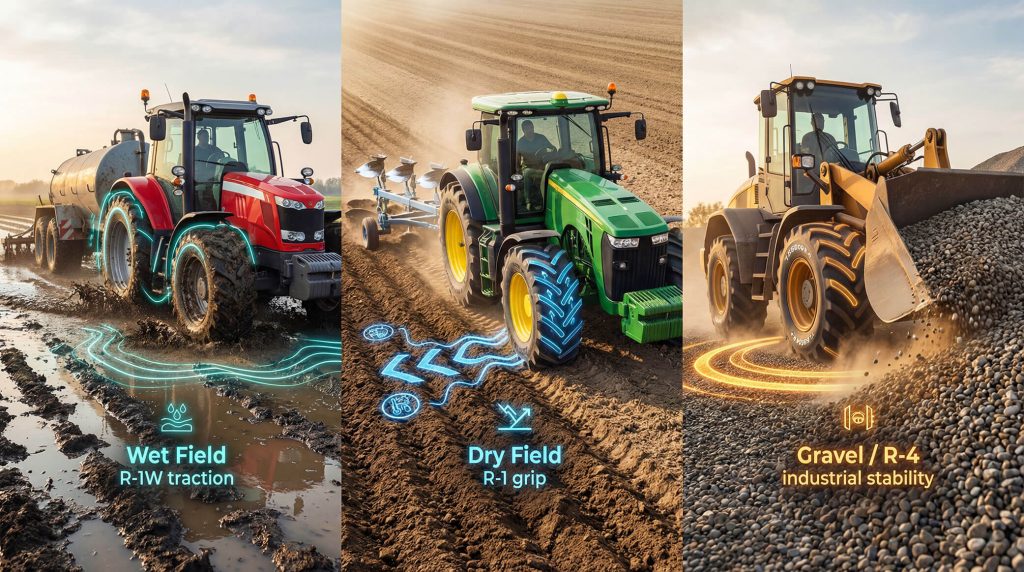
When you think of a farm tractor, you are thinking of R-1 tires tractor treads.
The Look: These have long, separated bars (lugs) angled at roughly 45 degrees.
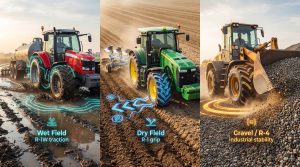
The Job: They are designed for general farming. The wide space between the lugs allows the tire to “self-clean” by shedding mud with every rotation. They provide the best grip in dry farming soil.
R-1W Tires (Wet Traction)
This is a variation of the standard R-1, very popular in Europe and wetter parts of the US.
The Difference: The “W” stands for “Wet.” The tread depth is about 20% deeper than a standard R-1.
The Job: Perfect for heavy, sticky soils or fields that stay wet longer. The deeper tractor treads give you extra bite and a longer lifespan on the road.
R-2 Tires (Rice and Cane)
These are the monsters of the mud world.
The Look: Extremely deep lugs—sometimes twice as deep as an R-1.
The Job: Designed specifically for rice paddies or sugar cane farming in standing water. They are essentially paddle wheels. You would rarely use these for general dry farming because they wobble terribly on hard ground.
R-3 Tires (Turf)
The Look: Instead of bars, these have a diamond or button pattern, similar to a golf cart but bigger.
The Job: Flotation. They are designed to roll over grass without digging in. You will find these on tractors used for mowing parks, golf courses, or sports fields.
R-4 Tires (Industrial)
The Look: The lugs are shallower and wider than R-1s, looking almost like a continuous bar in the center.
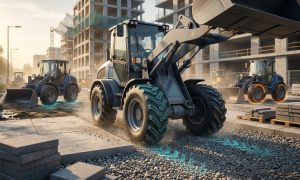
The Job: These are R-4 tractor tires, typically found on yellow construction equipment (backhoes, telehandlers). They are built for hard surfaces like concrete and gravel.
Balancing Traction vs Soil Preservation
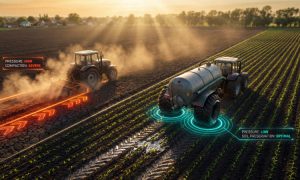
One of the biggest challenges in choosing a tread is the tradeoff between pulling power and soil health.
The Conflict
To get maximum traction (pull), you want sharp, deep lugs that penetrate the soil like a gear. This is what R-1 tires tractor designs do best. However, this digging action can disturb the soil structure.
To preserve the soil, you want “flotation.” You want the tire to sit on top of the ground. R-4 tractor tires or R-3 turf tires are better at this because they have more rubber touching the surface.
The Modern Solution
Modern radial technology helps balance this. A radial R-1-W tire (like the TVS Eurogrip AR 4005) offers the deep tread needed for traction but has a flexible sidewall that flattens out the footprint. This gives you the “bite” of an R-1 with the “float” of a wider tire.
Industrial vs Ag Tires: Which Do You Need?
The debate of industrial vs ag tires (R-4 vs R-1) is the most common question for compact tractor owners.
- Choose Ag (R-1) If: You are tilling gardens, plowing snow in a long driveway, or pulling a bush hog through muddy pastures. You need the tire to dig.
- Choose Industrial (R-4) If: You are doing loader work on a gravel driveway, stacking hay bales on a hard feedlot, or moving pallets on pavement. The R-4 tractor tires have tough sidewalls that handle the weight of a heavy loader bucket better than R-1s.
What Do Different Tractor Tyre Sizes Mean?
When shopping, you will see numbers like 460/85R38 on the sidewall. Understanding this is just as important as the tread pattern.
- 460: The width of the tire in millimeters.
- 85: The aspect ratio (the sidewall height is 85% of the width).
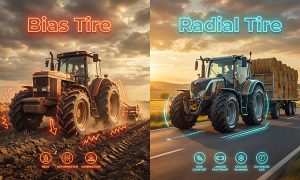
- R: Radial construction (superior to bias for field work).
- 38: The rim diameter in inches.
Knowing the correct size ensures you get the right cost of tractor tires estimate and that the tire fits your specific rim.
Tractor Tires for Trucks?
A growing trend in off-road communities is putting tractor tires for trucks (mud boggers). While this looks impressive, it is important to note that standard R-1 tires are not DOT-approved for highway use.
The Risk: Tractor tires are made for low-speed, high-torque work (20-30 mph). Putting them on a truck doing 60 mph generates dangerous heat and can lead to a blowout.
The Exception: Some specialized “MPT” (Multi-Purpose Truck) tires offer a tractor-like tread but are engineered for higher speeds.
Conclusion
The tractor tyre tread pattern plays a critical role in farm productivity. It influences how well the tractor grips the soil, how much it protects the land, and how long the tyres last.
Choosing the right tread pattern helps farmers work efficiently, reduce fuel costs, and preserve soil health. Whether you choose R-1, R-4, or another tread type, matching the tread to your farm work is the key to long-term success.
Frequently Asked Questions (FAQs)
How do I know if I need R-1 or R-4 tires?
Ask yourself: “Where do I spend 80% of my time?” If it is in a muddy field or garden, get R-1 tires tractor treads. If it is on a gravel driveway, barnyard concrete, or construction site, get R-4 tractor tires.
What is the difference between R-1 and R-1W?
The “W” stands for Wet. R-1W tires have a tread depth that is about 20% deeper than standard R-1 tires. This provides better traction in sticky soils and longer overall tire life, making them a popular choice for modern radials like the 460/85R38 sizes.
Why are tractor tires so expensive?
The cost of tractor tires reflects the massive amount of raw material (rubber and steel) and the engineering required. A single rear tractor tire can weigh hundreds of pounds and must withstand massive torque without slipping on the rim.
Can I put tractor tires on my pickup truck?
Technically yes, for off-road mud bogging. However, standard tractor treads are not safe for highway speeds. They will overheat, vibrate violently, and wear out in just a few hundred miles of pavement driving.
How does tread pattern affect fuel economy?
A tire that slips is a tire that wastes fuel. Using a shallow R-4 tire in deep mud causes high “slip percentage,” forcing your engine to work harder. Using the correct aggressive treading of tyres (like an R-1) grips the soil efficiently, saving diesel.