
Aron Calvin Vijaykhar
Global Product Manager | Marketing & Brand Management Head
The construction industry is the undeniable backbone of India’s rapid economic development. From paving rural roads under the Pradhan Mantri Gram Sadak Yojana to constructing towering skyscrapers in Mumbai and expanding metro networks across tier-2 cities, the demand for fast, reliable concrete is at an all-time high.
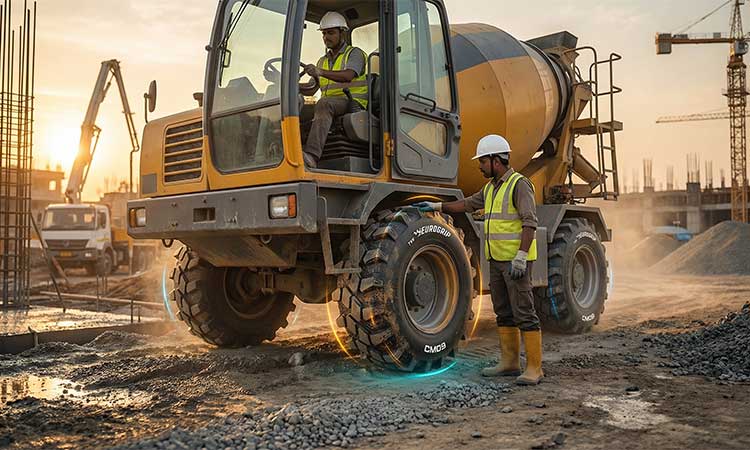
In recent years, one specific piece of machinery has revolutionized how concrete is delivered and poured on Indian job sites: the Self-Loading Concrete Mixer (SLCM). Often described as a “mobile batching plant,” these ingenious machines can independently load raw materials, mix them to exact specifications, transport the concrete, and discharge it exactly where it is needed. This eliminates the need for manual mixing, slashes labor costs, and drastically boosts operational efficiency.
For contractors and fleet managers operating in India, the SLCM is no longer a luxury; it is a necessity. In this comprehensive guide, we will dive deep into the price, quality, and availability of SLCMs in India. Most importantly, we will explore the critical component that keeps these massive machines moving across unforgiving terrains: the Construction & Industrial Tyres that bear the load.
The Indian Market | Global Hub for SLCMs
While SLCMs are considered niche equipment in some Western markets, India is arguably the largest and most dynamic market for these machines in the world.
Why India Loves the SLCM?
In India, setting up a massive, stationary ready-mix concrete (RMC) batching plant is not always feasible. The geographical diversity and logistical challenges of the subcontinent make the SLCM the perfect “economical alternative.”
- Remote Locations: Whether building a dam in the foothills of the Himalayas or setting up wind farms in the deserts of Rajasthan, SLCMs can travel to sites where transit mixers cannot reach.
- Tight Urban Spaces: Navigating the narrow, congested streets of older Indian cities is impossible for a massive transit truck. The compact turning radius of an SLCM makes it ideal for urban infrastructure upgrades.
- Mass Adoption: They are used everywhere, from canal lining projects in Gujarat to rural road construction in Odisha.
Domestic Powerhouses
India boasts a incredibly robust manufacturing ecosystem for these machines. It is a true “Make in India” success story. Brands like Ajax Engineering (the undisputed market leader), Schwing Stetter India, Apollo Carmix, and Macons produce thousands of units annually, tailored specifically for the harsh Indian operating environment.
Price Breakdown: The Cost of Ownership in India
One of the primary reasons SLCMs have seen explosive growth in India is their cost-efficiency compared to imported machinery or stationary batching plants.
New Unit Price: A brand new, high-quality SLCM manufactured in India typically ranges from ₹25 Lakhs to ₹50 Lakhs depending on the drum capacity (usually ranging from 2.5 cubic meters to 4.5 cubic meters) and the level of electronic batching automation included.
Used Unit Price: The secondary market for SLCMs in India is also thriving. A well-maintained, used SLCM can be acquired for ₹10 Lakhs to ₹20 Lakhs, making it highly accessible for smaller sub-contractors.
By utilizing local steel, domestic engines (like Kirloskar or Mahindra), and local labor, Indian manufacturers have driven down the cost of production while maintaining robust profit margins for fleet owners.
Quality & Specs: Built for the Indian Terrain
Indian SLCMs are built for outright abuse. They are engineered to survive extreme dust, scorching summer heat, and the deep, sticky mud of the monsoon season.
Durability Over Luxury: While European models might focus on air-conditioned cabs and delicate digital sensors, Indian models prioritize functional ruggedness. They use mechanical workhorse engines that can be serviced by local mechanics in remote villages without the need for specialized diagnostic laptops.
Four-Wheel Drive & Steering: To navigate deep mud and steep inclines, most Indian SLCMs feature 4×4 drive and 4-wheel crab steering, making them incredibly agile.
BS-IV/V Compliance: Modern Indian machines adhere to strict CEV Stage IV or V emission norms, ensuring they are environmentally compliant without sacrificing the raw torque needed to mix concrete on the move.
The Critical Component: Tyres
Whether you are operating a ₹25 Lakh machine in Nagpur or a top-of-the-line ₹50 Lakh model in Bengaluru, one operational truth remains constant: your machine is only as good as the rubber connecting it to the ground.
SLCMs are unique beasts. They carry massive, shifting, liquid loads (wet concrete) while navigating rough, unpaved terrain. A standard truck tyre would instantly burst or deform under the dynamic pressure of a rotating mixing drum. This is exactly where specialized Concrete Mixer Machine Tyre solutions come into play.
For these uniquely demanding machines, TVS Eurogrip OHT offers the CM 09, a Self-Loading Concrete Mixer tyre engineered specifically for the rigorous, daily cycle of loading, mixing, and dumping.
Let’s break down the technical specifications that make the SLCM Tyres CM 09 the industry standard in India:
1. The Perfect Size
The most highly recommended fitment for medium-to-large SLCMs (such as the popular 4 cubic meter models) is the SLCM Tyres 400/70-20. This specific size offers an exceptionally wide footprint. When working on a freshly excavated site, this wide stance ensures the heavy machine achieves maximum flotation and does not sink into soft mud, loose gravel, or wet sand.
2. Mastering the Weight: Load Index & Speed Symbol
When analyzing a Cement Mixer Construction Tires specification, the load index is the most vital metric. The CM 09 features a Load Index & Speed Symbol 155A8.
155 (Load Index): This indicates that the tyre can carry a massive dynamic weight, specifically 3,875 kg per tyre. When an SLCM is full of wet concrete, the weight distribution shifts dramatically with every rotation of the drum. You need heavy-duty, off-road tyres that can handle nearly 4 tons of pressure per wheel without the sidewall buckling.
A8 (Speed Symbol): This indicates the tyre is rated for a maximum safe speed of 40 km/h. SLCMs require massive low-end torque and stability, not highway speed. The A8 rating ensures maximum safety while transferring materials across a busy, hazardous job site.
3. Engineering Stability Metrics
For a machine that constantly mixes a heavy liquid payload, a low center of gravity and absolute stability are non-negotiable to prevent rollovers.
Static Load Radius 410 (mm): This measures the distance from the wheel center to the ground when the tyre is under maximum load. A highly stable static load radius is crucial. If the tyre “squishes” or deforms too much under the weight of the concrete, the machine becomes critically unstable.
Rolling Circumference 3285 (mm): This is the exact distance the tyre travels in one complete revolution. A precise and consistent rolling circumference ensures that the SLCM’s complex 4-wheel drive and 4-wheel steering systems operate efficiently without straining the transmission or axles.
4. Specialized Tread Design
A high-quality tyre in this category must act as a Light-Duty Concrete Mixer Tyre in terms of steering agility, but it must possess heavy-duty strength for durability. Sometimes referred to in procurement circles as a Self-Lading Mixture Tyre, the TVS Eurogrip OHT CM 09 delivers on both fronts.
Cut & Chip Resistance: Indian construction sites are notoriously littered with exposed rebar, sharp demolition rocks, and jagged debris. The specialized rubber compound of the CM 09 heavily resists the cuts, chips, and chunking that would rapidly destroy lesser tyres.
Non-Directional Lug Pattern: This tread design allows for equal, powerful traction in both forward and reverse gears. This is absolutely essential for an SLCM, a machine that spends half its operational life backing up to precisely pour concrete into trenches or formwork.
Availability & After-Sales Support in India
One of the greatest advantages of operating SLCMs in India is the sheer availability of both the machines and their crucial spare parts.
Because brands like Ajax, Schwing Stetter, and Apollo manufacture domestically, they boast extensive dealership and service networks in almost every major district across the country. Furthermore, finding replacement self loading concrete mixer tyres is a seamless process. Whether you are procuring through an authorized TVS Eurogrip OHT distributor, local heavy equipment vendors, or online B2B marketplaces, high-quality replacements are always within reach, ensuring your project never suffers from extended downtime.
Conclusion
The Self-Loading Concrete Mixer has fundamentally transformed the speed and economics of construction in India. By bridging the gap between manual mixing and massive transit operations, domestic manufacturers have provided a machine perfectly suited to the Indian landscape.
However, extracting the maximum return on investment (ROI) from these machines requires paying close attention to the ground up. By equipping your fleet with premium, purpose-built self loading concrete mixer tyres, featuring globally optimized specs like the Static Load Radius 410 and Rolling Circumference 3285 you ensure that your machines remain stable, efficient, and puncture-free.
For contractors who value maximum uptime, strict cost control, and uncompromising site safety, Indian SLCMs paired with TVS Eurogrip OHT tyres remain the smartest, most profitable choice for 2026 and beyond.
Frequently Asked Questions (FAQs)
What is the average price of a Self-Loading Concrete Mixer in India?
A brand new SLCM manufactured in India typically ranges from ₹25 Lakhs to ₹50 Lakhs, depending on the drum capacity (usually 2.5 to 4.5 cubic meters) and the brand. Used models in good condition can be found between ₹10 Lakhs to ₹20 Lakhs.
What is the recommended tyre size for a standard 4 cubic meter SLCM?
The most common and highly recommended size for medium-to-large capacity mixers is the SLCM Tyres 400/70-20. The TVS Eurogrip OHT CM 09 in this size is an industry favorite due to its wide footprint and exceptional load-bearing stability.
What does the "155A8" rating mean on my concrete mixer tyre?
This refers to the Load Index & Speed Symbol 155A8. The “155” means each tyre can safely support 3,875 kg of weight. The “A8” indicates that the tyre is engineered for a maximum safe operating speed of 40 km/h, which is perfect for heavy-duty site work.
Why are "Static Load Radius" and "Rolling Circumference" important for SLCMs?
The Static Load Radius 410 (mm) dictates how much the tyre compresses under the weight of wet concrete; maintaining this radius prevents the machine from tipping over. The Rolling Circumference 3285 (mm) ensures that the 4-wheel drive transmission works smoothly without mechanical binding.
Can I use standard tractor tyres instead of specialized SLCM tyres?
No, it is highly inadvisable. Standard tractor tyres have flexible sidewalls designed for pulling through agricultural soil. A Concrete Mixer Machine Tyre requires incredibly stiff sidewalls and cut-resistant compounds to handle the massive, shifting vertical weight of concrete on rocky, debris-filled construction sites.