
Aron Calvin Vijaykhar
Global Product Manager | Marketing & Brand Management Head
Farming has changed. Your grandfather likely used a small tractor that did one job: ploughing. Today, you might be driving a 50-horsepower machine that prepares the seedbed in the morning, hauls sugarcane to the factory in the afternoon, and powers a thresher in the evening.
As your equipment has evolved, so have the tyres that carry it. But with terms like “Bias-Ply,” “Radial,” and “VF” thrown around by dealers, how do you know which one is actually right for your farm? Choosing the wrong agricultural tyre technology can lead to wasted diesel, compacted soil, and tyres that wear out too fast on Indian roads.
In this guide, we will break down the three main tyre technologies available today, compare bias-ply tyres vs radial tyres, and help you decide which one matches your machinery and budget.
How Agricultural Tyre Technology Has Evolved?
Earlier, Indian farms mostly used bias-ply tyres because they were affordable and durable. As tractors became more powerful and farm operations expanded, tractor radial tyres were introduced. Today, even more advanced technologies like IF and VF tyre constructions help reduce soil compaction and improve fuel efficiency.
Farmers now have options based on:
- Soil type
- Crop system
- Implement weight
- Monsoon influence
- Field + road usage
- Tyre maintenance practices
The right choice depends on your equipment and environment — not just price.
1. Bias-Ply Technology: The Rugged Workhorse
For decades, bias-ply tyres have been the standard in India. If you look at an older tractor, it is almost certainly wearing these.
How It Works?
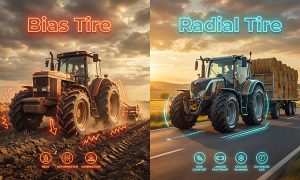
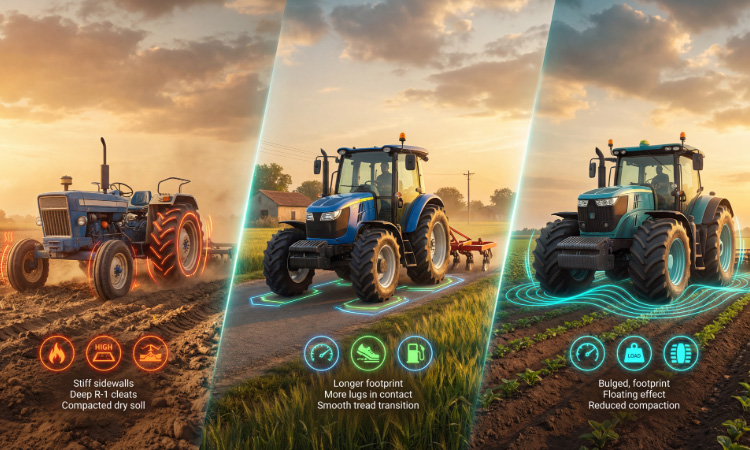
In a bias-ply tyre, the internal cords (plies) are layered diagonally, crisscrossing each other at angles of about 30 to 40 degrees. This creates a very stiff, rigid structure where the sidewall and the tread function as one single unit.
Pros for Indian Farms
- Sidewall Strength: Because the sidewalls are thick and stiff, they are highly resistant to cuts and punctures. This is excellent for durable farm tyres for Indian conditions, especially if you drive over thorny brush or rocky terrain.
- Stability: The stiff sidewalls don’t wobble. This makes bias tyres great for lifting heavy loads with a front-end loader or for working on hillsides where you need stability.
- Cost: They are simpler to manufacture, making them more affordable upfront.
Cons
- Rough Ride: Because the tyre is so stiff, you feel every bump in the field. This can be tiring for the operator.
- Soil Compaction: The stiff footprint doesn’t spread out. It concentrates the weight in a small area, digging into the soil and causing compaction.
Best For: Small to medium tractors used for general utility, rough off-road clearing, or farmers on a strict budget who don’t do heavy tillage.
2. Radial Technology: The Efficiency Expert
Tractor radial tyres are the modern standard for serious farming. While they cost more initially, they often pay for themselves in fuel savings and crop yields.
How It Works?
In a radial tyre, the internal cords run straight across the tyre (at 90 degrees) from bead to bead. The tread is then reinforced with separate steel or fabric belts. This allows the sidewall to be flexible while the tread remains flat on the ground.
Pros for Indian Farms
- Fuel Efficiency: Radials have lower rolling resistance. The engine doesn’t have to work as hard to move the tractor forward, which can save significant amounts of diesel over the tyre’s life.
- Better Traction: Because the sidewall flexes, the tyre puts a larger “footprint” on the ground. More lugs touching the soil means better grip and less wheel slip.
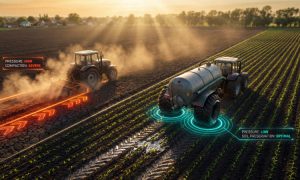
- Soil Protection: The larger tyre footprint for crop farming spreads the weight of the tractor. This reduces soil compaction, helping your roots grow deeper.
- Road Comfort: The flexible sidewalls act like a shock absorber, giving you a smoother ride on rough village roads.
Cons
- Sidewall Vulnerability: The sidewalls are softer than bias tyres, so you must be careful around sharp rocks or scrap metal.
Best For: Primary tillage tractors, mixed-use tractor tyres (field + road), and farmers looking to maximize diesel efficiency.
3. VF Technology: The Future of Farming
If you have heavy machinery or are very concerned about soil health, you need to know about VF (Very High Flexion) technology. This is an advanced version of the radial tyre.
How It Works?
VF tyres use high-tech materials that allow the sidewalls to flex significantly more than standard radials without getting damaged.
- The Rule: A VF tyre can carry 40% more load at the same air pressure as a standard radial.
- OR: It can carry the same load at 40% reduced air pressure.
Pros for Indian Farms
- Ultimate Soil Protection: By running at lower pressures, these soil compaction reduction tyres float over the field like a hovercraft. This preserves the soil structure for your next crop.
- No Pressure Changes: With standard tyres, you should inflate them for the road and deflate them for the field. With VF tyres, you can often find a “sweet spot” pressure that works for both, saving you time.
Best For: Heavy harvesters, high-horsepower tractors, and farmers who want the absolute best for their soil biology.
Which Technology Fits Your Application?
To choose the best agricultural tyre technology, look at what your tractor actually does all day.
Scenario A: For Haulage
- Task: hauling sugarcane or grain trailers on highways 60% of the time; field work 40%.
- Challenge: Tyres heat up on the road and wear out fast.
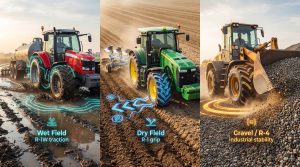
Solution: Radial Tyres. The heat-resistant construction and flat tread wear more evenly on tarmac than bias tyres.
Scenario B: For Wetland
- Task: Puddling in rice paddies.
- Challenge: Getting stuck in deep mud.
Solution: High-Lug Bias or Radial. You need deep traction. While radials provide better flotation to stop sinking, some farmers still prefer the sharp “bite” of a specialized deep-lug tyre.
Scenario C: For Wetland
- Task: Combine harvesters or heavy grain carts.
- Challenge: The machine is so heavy it crushes the field.
Solution: VF Technology. This is the only way to carry that massive weight without destroying your land’s potential.
Conclusion
Agricultural tyre technology has become a key part of farm productivity in India. Bias-ply tyres offer strength for basic work, while radial tyres give superior traction, soil protection, comfort, and fuel savings. With newer IF and VF technology, farmers can handle heavy implements and soft soils with greater confidence.
The right choice depends on your tractor’s workload, implements, soil type, and crop seasons. Choosing smart tyre technology today protects your soil, your tractor, and your income tomorrow.
Frequently Asked Questions (FAQs)
Do radial tyres really save fuel?
Yes. Tractor radial tyres have flexible sidewalls that allow the tyre to move more easily over the ground. This reduces rolling resistance. Studies show that radials can improve fuel efficiency by 3-5% or more compared to bias tyres.
Can I mix bias and radial tyres on my tractor?
No, this is dangerous. Bias-ply tyres vs radial tyres have different handling characteristics. Mixing them can cause instability, poor steering, and uneven wear. Always match the technology on the same axle, and preferably on the whole machine.
What is the benefit of VF technology for Indian farmers?
VF (Very High Flexion) technology allows you to carry 40% more load without increasing air pressure. This is perfect for Indian farmers who often haul heavy loads but want to avoid deep soil compaction when they enter the field.
How does tyre pressure affect tyre life?
Improper tyre inflation & pressure management is the #1 killer of tyres. Under-inflation on the road causes heat buildup and sidewall cracks. Over-inflation in the field causes slippage and soil damage. Regular pressure checks are essential for durability.