
Jed Soar
European Director - Technical Services & Product Performance
Let's take a Closer Look at Technology, Education, and Accountability
In today’s modern agricultural sector—where efficiency, soil health, and machinery investment intersect—the importance of operating tyres at the correct pressure for both load and speed cannot be overstated. Yet, across the industry, a surprising number of tyres are still being operated far outside their optimal pressure ranges. Nowhere is this more evident than in the misuse of Very High Flexion (VF) tyres, a technology specifically designed to deliver superior performance at lower pressures.
The VF Tyre Paradox
It’s becoming increasingly common to see VF tyres fitted to tractors and implements for their promised benefits: reduced soil compaction, improved traction, and fuel efficiency. Yet despite these capabilities, operators are often running these tyres at pressures more suited to traditional bias-ply tyres or older radial models—sometimes up to three times the recommended pressure for field operations.
Take, for example, a recent case of a 300hp tractor conducting deep draft cultivation on a heavy clay field. The machine was fitted with high-spec VF 710/70R42 rear tyres, designed to run at 0.8 bar (11.6 psi) in field conditions. Upon inspection, they were inflated to 2.5 bar (36.3 psi). When asked why the tyres were set so high, the driver shrugged: “It goes on the road.”
This disconnect between the purpose of the tyre and how it’s used points to a broader issue in the sector.
Transition Trouble: From Bias to Radial to VF
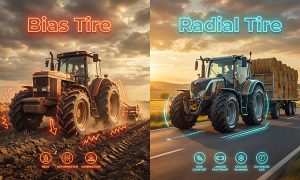
Part of the problem lies in the technological transition. Many operators are still thinking in terms of bias or early-generation radial tyres. VF tyres—designed to flex more and carry loads at lower pressures—represent a significant shift, but one that hasn’t been matched by an equivalent change in user behaviour.
This isn’t merely about farmer resistance to change. The issue runs deeper: into the very supply chain that supports and advises end users.
Where Are the Dealers?
Dealers are the crucial link between the manufacturers and the farmers. Yet in far too many cases, tyre dealers are not adequately trained-or motivated-to educate customers on the capabilities and requirements of modern tyre technology. The result is a widespread lack of understanding, not just among end users but within the supply network itself.
Some dealers treat the sale as the endpoint. Once the tyre leaves the workshop, the responsibility, in their view, ends. There’s no follow-up, no inflation guide left in the cab, and often no discussion of load/speed tables or field/road adjustment protocols. This abdication of post-sale service is not just negligent- it’s damaging.
The Warranty Fallout
Ultimately, this lack of education and engagement circles back to the manufacturers, who are left to pick up the pieces when tyres fail prematurely. Sidewall cracking, bead fatigue, and carcass separation—failures often caused by consistent over-inflation or misuse—become the subject of contentious warranty claims.
Manufacturers are then forced into the difficult position of having to deny support for what are clearly avoidable failures, creating friction with customers who feel unsupported. Worse, the blame often lands with the technology itself, when the real issue is human: poor communication, limited training, and insufficient accountability.
What Needs to Change?
Dealer Education Must Be Non-Negotiable: Tyre manufacturers should not sell VF or other advanced technologies through dealers who have not completed certified training. A minimum knowledge standard must be enforced, just as with machine servicing.
Operators Need Accessible Tools: Tyre pressure calculators, in-cab stickers, mobile apps—these tools must be part of the delivery process. Dealers should not just mount the tyre; they should leave behind the knowledge to operate it correctly.
Service Agreements, Not Just Sales: Dealers should be incentivized or even contractually obligated to conduct annual checks or offer on-farm consultations. Tyre performance isn’t a static thing—it changes with implement, load, and terrain.
Manufacturers Must Protect Their Innovation: If VF tyres continue to be misused, their reputation—and the significant investment behind them—will suffer. Manufacturers need to take a firm stand with their dealer networks, encouraging better practices and cutting ties with repeat offenders.
The Role of Digital Tyre Monitoring Systems
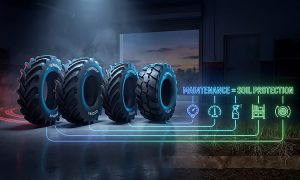
Smart tyre pressure monitoring systems (TPMS) are becoming a standard feature in high-end tractors and harvesters. These sensors automatically adjust inflation based on load, terrain, and speed. Integrating these systems ensures that VF tyres perform at their designed flexion range, avoiding over-inflation issues common in mixed field-to-road use. When combined with mobile apps or cloud platforms, digital monitoring closes the feedback loop between dealer, operator, and manufacturer, making pressure control more proactive than ever.
Why Correct Tyre Pressure Still Matters for Soil and Sustainability?
Maintaining correct tyre pressure isn’t just about extending tyre life, it’s about protecting the ground that feeds the farm. Over-inflated tyres increase soil compaction, reducing pore space for water and roots, while under-inflated tyres can cause instability and excessive heat build-up. Both outcomes raise fuel consumption and mechanical stress.
In modern farming, where machinery is heavier and field time is tighter, the consequences multiply. A single bar of extra pressure can add several tonnes of weight per wheel to the soil, accelerating structure collapse. Conversely, using load-specific inflation data ensures maximum footprint, fuel efficiency, and less rutting. Precision inflation management not only saves operating costs but supports long-term soil sustainability, a growing metric in regenerative and precision agriculture programs.
Conclusion
The agricultural sector stands at a crossroads where technology is far ahead of its application. VF tyres offer real, measurable benefits—but only when used correctly. Until the entire supply chain, from manufacturer to dealer to operator, is aligned in understanding and applying correct tyre pressure for both load and speed, the full potential of this technology will remain unrealised. And in the meantime, tyres will continue to be unfairly blamed for failures that have more to do with neglect than design.
Frequently Asked Questions (FAQs) on Alignment in Agriculture
Why is tyre pressure so important in farming?
Proper inflation ensures optimal contact with the ground, improving traction, fuel efficiency, and reducing soil compaction.
What happens when tyres are over-inflated?
Over-inflation hardens the tyre footprint, increases soil compaction, and accelerates wear on VF tyres, often causing premature sidewall or bead damage.
Can under-inflation damage agricultural tyres?
Yes. Running below recommended levels creates excess flexing, heat build-up, and tread distortion, which weakens the internal casing.
How do VF tyres differ from regular agricultural tyres?
VF (Very High Flexion) tyres carry the same load at 40% lower pressure, improving comfort, grip, and soil protection, provided they’re used at the correct pressure.
How can farmers check the right pressure for field and road use?
Use the manufacturer’s load-speed tables or mobile apps, adjusting between field (lower pressure) and road (higher pressure) settings for accurate performance.
Do digital pressure monitoring systems help?
Yes. TPMS devices automatically alert operators when inflation drifts from the optimal range, helping maintain tyre health and improve fuel efficiency.