
Aron Calvin Vijaykhar
Global Product Manager | Marketing & Brand Management Head
A modern tractor is a massive machine. It costs a lot of money and has a huge engine. It can pull heavy plows, plant thousands of seeds, and move massive trailers. But all of that engine power means nothing if the rubber wheels cannot hold onto the dirt. The secret to a strong machine is the air inside the wheels. You must control your Tractor Tyre Pressure to get the most out of your farm equipment.
Many farmers buy great tyres but ignore the air inside them. This is a big mistake that costs money every single day. When you understand how air changes the shape of the tyre, you gain total control over your machine. A tyre with too much air will bounce, slip, and waste expensive diesel fuel. A tyre with too little air can break under a heavy load. You need the exact right amount of air for the specific job you are doing today.
TVS Eurogrip OHT builds advanced radial tyres that work perfectly with careful air management. This complete guide will show you how these tyres work. You will learn the simple rules of grip, how to measure your air properly, and how changing your air levels makes your farm produce more food.
The Basic Rules of Air and Grip
Air pressure changes the shape of the tyre. When a tyre sits on the ground, the flat part that touches the dirt is called the “footprint.”
If you put too much air in the tyre, the footprint shrinks. Only the very middle of the tyre touches the dirt. This causes the tractor to slip and spin its wheels. It also makes the tractor bounce on hard dirt, giving the driver a terrible ride.
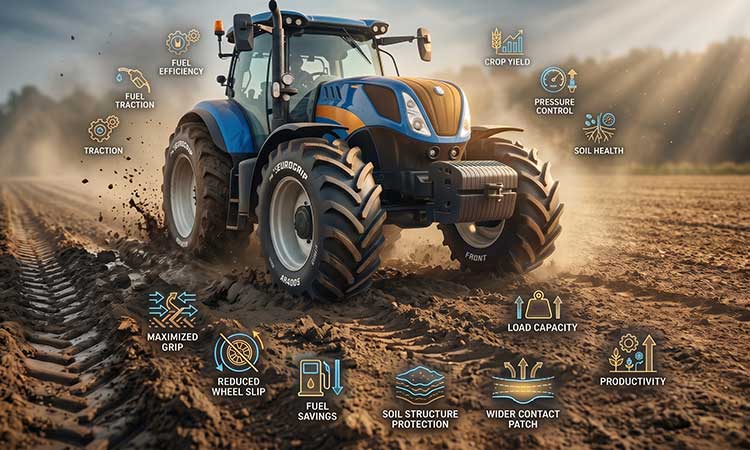
If you let some air out, the tyre flattens down. The footprint becomes long and wide. This puts more rubber lugs (the thick blocks) on the dirt. The tyre acts like a giant snowshoe. It grips the soil tightly and pulls the tractor forward without spinning. This is why a simple tractor tyre pressure adjustment makes the engine work better and saves expensive diesel fuel.
Why Adjusting Tractor Tyre Pressure Improves Field Productivity
Changing the air in your wheels is the fastest, cheapest way to make your tractor work better. A simple tractor tyre pressure adjustment takes only five minutes before you start your engine, but it changes your entire workday. Here are five major reasons why you must pay attention to your air.
Stop Wheel Slip to Save Money
Diesel fuel is one of the biggest costs on any working farm. When a tyre has too much air, the footprint is small, and the wheel spins in the dirt. This spinning is called “tyre slip.” When the wheel slips, the engine works at full maximum power, burning massive amounts of fuel, but the tractor barely moves forward. Good farm tyre pressure management stops tyre slip completely. A flat, wide footprint grips the dirt and pulls the tractor forward on the very first try. This simple change saves you hundreds of dollars in wasted fuel every season.
Support Heavy Weights Safely
Farms in the United States operate on a massive, industrial scale. An American farmer often drives huge machinery to pull heavy grain carts and incredibly wide seed planters across thousands of acres. These giant tools put extreme weight onto the back of the tractor. You must have the correct tyre pressure for heavy farm loads. If the air is too low when pulling a giant grain cart on a hard highway, the heavy weight will crush the sidewall of the tyre. The rubber will get too hot and break from the inside. American farmers rely on a strict tractor tyre pressure guide to raise their air before hitting the road, keeping the job moving without a dangerous blowout.
Keep the Soil Soft for Growing
In European countries, farm space is very tight and highly regulated. Farmers must grow as much food as possible on every single acre they own. The biggest threat to their harvest is soil compaction. When a heavy tractor drives over a wet field, the heavy wheels press the soft dirt down so hard that it turns into a solid brick. Plant roots cannot grow deep into solid dirt. Rainwater just runs off the top instead of reaching the seeds. European farmers use tractor tyre pressure for soil protection. By letting air out, the weight of the massive tractor spreads out over a huge footprint. When you reduce soil compaction with proper tyre pressure, the soil stays loose, soft, and healthy. Because the soil is healthy, the plants grow much larger. This proves that there is a direct link between tyre pressure and crop yield.
Drive Through Deep Water and Sludge
During the heavy rainy season in India, the farming fields turn into deep, thick mud. A tractor must drive directly through flooded paddy fields and slippery, unpaved village roads just to get to work. Driving in these extreme conditions requires special tyre pressure for soft soil farming. If a wheel is pumped full of air, it will slice into the Indian mud like a sharp knife. The heavy tractor will sink all the way down to its axles and get stuck instantly. To survive the mud, the driver must find the perfect tractor tyre pressure for farming. By dropping the air to the lowest safe level, the tyre flattens out and floats on top of the wet mud instead of sinking.
Front Tyres vs Rear Tyres
A tractor is not balanced like a normal car. The back of the tractor is usually much heavier than the front. This means the front tyres and back tyres need totally different amounts of air. There is no single average tractor tyre pressure for the whole machine.
The Front Wheels
The tractor front tyre air pressure depends on what the tractor is doing. If the tractor has a heavy front loader bucket full of gravel, the front tyres need high air pressure to hold the heavy load. If the front bucket is empty, the air pressure should be lower to provide a smooth ride and better steering in the dirt.
The Rear Wheels
The rear tyres do all the pushing. They are huge and hold massive amounts of air volume. The inflation pressure of rear tyre of tractor is usually lower than you might think. Many farmers are surprised to learn that a giant rear tyre might only need 12 to 15 PSI (Pounds per Square Inch) for field work. Finding this exact number is the key to perfect tractor tyre pressure for farming.
Best TVS Eurogrip Radial Tractor Tyres
At TVS Eurogrip OHT, we engineer a range of premium radial tyres specifically designed to respond perfectly to your careful air pressure changes. Radial tyres have flexible sidewalls and strong, flat treads, making them the absolute best choice for mixed farm work. Let’s break down the heroes of our lineup.
If your farm is full of soft soil and requires maximum traction and soil protection, this is your ultimate choice.
- Design: Built with advanced VF (Very High Flexion) Technology.
- Why Choose It: This tyre allows you to drop the air pressure extremely low. The huge footprint provides massive contact area, self-cleaning in the mud, and the ultimate protection against soil compaction. It can carry heavy loads even at low field pressures.
- Design: Features a classic R-1W deep tread depth.
- Why Choose It: When the pressure is set correctly for soft soil, the deep, angled lugs provide excellent self-cleaning action. As the soft tyre flexes against the ground, it pushes wet mud out of the grooves, ensuring you always have a clean edge to grip the dirt.
Designed for modern farmers who shift between soft dirt fields and hard paved highways every single day.
- Design: Radial construction with thick nose bars and overlapping center lugs.
- Why Choose It: When you raise the air pressure for the road, the overlapping center blocks provide a smooth, fast ride without bouncing. When you lower the pressure for the field, the deep shoulder lugs dig deep into the earth for maximum pulling power.
When you pull massive equipment, you need the extreme strength of the HS series.
- Design: The HS 3000 is a heavy-duty R-1W radial built for giant 4WD tractors. The HS 1000 is a classic R-1 radial for daily mixed utility.
- Why Choose It: The strong radial construction allows you to safely lower the air pressure even when a massive grain cart or seed planter is pushing down heavily on the rear axles.
- Design: A very tall, extremely narrow R-1 tyre.
- Why Choose It: Built specifically to drive exactly between tight rows of crops without crushing the delicate plants. Because it is so narrow, the internal air space is small. Setting the exact right air pressure is absolutely critical here to carry the machine’s weight safely without damaging the field.
Guide to Check and Maintain Air
Now that you know why air matters, you must know how to check tractor tyre pressure. You cannot just kick the tyre or look at it with your eyes. A large tractor tyre looks exactly the same at 10 PSI and 20 PSI, but it will drive completely differently. You must use a tool.
Here is a simple routine for daily tractor tyre pressure maintenance.
- Buy a Good Gauge: Buy a special liquid-filled pressure gauge made for farm tyres. A cheap car gauge will not work well for low-pressure tractor tyres.
- Check in the Morning: Always check the tyre pressure tractor in the morning before you start driving. When a tyre rolls, it gets hot. Hot air expands, which gives you a fake, high number on your gauge.
- Use a Chart: Never guess the numbers. Find the tractor tyre air pressure chart provided by TVS Eurogrip OHT or your tractor manual.
- Know Your Load: Weigh your heavy tools. Look at the chart. Match the weight of the tool to the speed you will drive. The chart will tell you the exact air pressure you need today.
- Adjust for the Road: If you finish field work and need to drive ten miles down a hard paved road, stop and add air. Driving on the highway with low field pressure will destroy your expensive radial tyres.
Simple Reference Table
Here is a basic look at how air pressure rules change based on your location.
Location | Ground Condition | Load Tyre | Action to Take |
|---|---|---|---|
Field Dirt | Soft, Wet, Loose | Heavy Plow | Lower the air pressure. Create a wide footprint for grip. |
Paved Road | Hard, Dry, Hot | Heavy Grain Trailer | Raise the air pressure. Support the heavy weight and reduce heat.
|
Farm Yard | Mixed Gravel | Front Loader Full | Raise front tyre pressure. Lower rear tyre pressure for comfort. |
Conclusion
TVS Eurogrip OHT knows that the rubber on your wheels is the only thing standing between your expensive tractor and the dirt. The smartest thing you can do for your farm is to control the air inside that rubber. By taking just five minutes every morning to check and adjust your tractor tyre air pressure, you change how your whole farm operates. You stop wasting expensive fuel, you protect your valuable soil, and you keep your heavy machines running safely. Follow the rules of air and grip, choose TVS Eurogrip OHT radial tyres, and secure a better harvest.
Frequently Asked Questions (FAQs)
Why does my tractor bounce so much on the dirt road?
Your tyres likely have too much air in them. High pressure makes the large tyre hard like a basketball. Check your manual and let some air out to match the road conditions for a smoother ride.
How often should I check my tyre pressure?
You should check your air pressure at least once a week. You must also check it any time you hook up a different, heavier tool to the back of the tractor.
What happens if my tyre pressure is too low on the highway?
Driving fast on a hard road with low air pressure is dangerous. The sidewall of the tyre will bend too much, causing the inside of the tyre to get extremely hot. The tyre can burst. Always add air before long road trips.
Can I put water inside my tractor tyres?
Yes. This is called liquid ballast. Many farmers pump water mixed with antifreeze into the large rear tyres. This makes the tractor much heavier, which pushes the tyres harder against the dirt for better pulling power.
Where do I find the correct pressure numbers for my farm?
Never guess the air pressure. You must look at the exact air pressure chart provided by the tyre manufacturer. TVS Eurogrip OHT provides charts that match your specific tyre size to the exact weight of your tractor.